GutFix was not built by people who picked a niche. One collapsed lung, one bad meal, and the same answer at the end of both. The short version is below, and then both stories in full.
Field entry I
16the age it started
Jeremy
Co-founder
Halfway home from handball training I had to sit down on the kerb, because the stabbing in my chest was bad enough that I couldn’t keep walking. My left lung had collapsed.
What happened
2 weeks in hospital, 2 operations, and a piece of my lung taken out.
The years after
That fortnight left my nervous system stuck on the accelerator. I kept adding. More supplements, more stacks, more of everything. It didn’t get better.
What turned it
Cutting, not adding.
What I do now
I build the part you hold, and I am the one using it every day.
Field entry II
12the age it started
Kieran
Co-founder
New school, a lot of stress, one bad meal, and my gut never felt the same again. Bloating I couldn’t walk off, gas I couldn’t release, and exam halls where my stomach made noises the whole room could hear.
What happened
Methane-dominant SIBO, the trapped kind. It shadowed my whole school life.
The years after
Every antimicrobial there is. Oregano, allicin, berberine. The SIBO came back every single time.
What turned it
It was never the bacteria. It was the environment they landed in.
What I do now
I wrote the rules for what belongs in a plan, and in what order.
I never had major health issues, not until I was 16.
I come from a handball background. I started playing when I was 6, and by the time this happened I was a competitive athlete in the small town I grew up in. Handball, training and sport were most of my life. 7 to 8 sessions a week between the gym, the court and cardio.
I still remember the day exactly. It was during the summer holidays, the last session of the week, a Friday. The funny part is the date, it was 9/11.
We were in pre-season preparation, everybody was up for the new season. We started the warm-up and I just did not feel right.
During the warm-up I felt a sharp stabbing in my chest. I thought it was a muscle thing, some tightness, so I carried on for another 5 or 10 minutes.
It got significantly worse. The pain sharpened until I had to tell my coach I was done, that I could not continue. I sat out the next 90 minutes on the sideline. I lay down, I rested, and I kept asking my coach what it could be. Maybe some kind of muscle strain?
I was in one of the best physical conditions of my life at that point. So I thought, okay, this is just a bit of overtraining catching up with me.
I set off walking home. In my hometown the sports hall is close to my home, 5-7 minutes on foot. Halfway there I had to sit down on the kerb because I could not keep walking. The stabbing was so strong I genuinely could not move.
I called my mum, and I remember talking myself through it, and I asked her to come and pick me up, because it was not happening on foot.
She picked me up. That evening I got into bed and rubbed some sports cream on the area, because nobody knew what this was. But as I was going to sleep I could already tell something was not right. It sounded wrong when I breathed in.
On top of that, because I am a fairly tall guy and I was quite skinny at the time, I could see my own heartbeat through my chest. And I could see that my heart had shifted badly, across into the middle of my chest, away from where it had always been. What I was looking at has a name. When one side of the chest loses its pressure like that, everything sitting in the middle gets pushed across.
At 5am the next morning I woke up with the stabbing even worse, and now it was pulling through into my back. Later I found out it is a similar pain to having a heart attack.
We went to A&E. The usual wait, about an hour, and then everything happened very fast. The doctor listened to my chest, sent me straight to X-ray, came back and said: you are going into surgery now, you have a pneumothorax.
I was 16. I had no idea what that meant, it was Latin to me. They explained it as simply as they could: your left lung has collapsed.
And in that moment something happened inside me that I would not understand for another 6 years.
My first reaction was not to meet the trauma with tears. My first reaction was to think: only the doctors can help me now.
That was, honestly, a very mature and very adult way to handle something like that. Looking back, it is what made me a stoic, and I loved stoic philosophy long before I knew what it was called. I focused on what I can control and what not.
They transferred me to the children’s hospital by ambulance.
They showed me the X-ray and I saw my lung was the size of a dumpling. The pneumothorax was severe. The paramedics told me they had never seen one like it, because these things are usually smaller, or at least they do not look that dramatic on the image.
Nobody ever established the cause. The doctors could not point at anything and say, that is what did it.
My own theory was that I had grown very fast and my organs had not kept up, so a lot of tension went onto the lung until it gave way. When I looked into it properly years later, that instinct turns out to be close to the leading explanation. Primary spontaneous pneumothorax overwhelmingly hits tall, thin young men between 15 and 40, and the accepted mechanism is that the pressure at the very top of the lung is higher in a body shaped like that, which is where the small weak spots form and where they burst.
Then came the first operation. They put a drain into my chest.
All I remember is being sedated and being gone about 10 seconds later, because holding that much pain had been exhausting for my body.
The doctors said afterwards that it had been close. The lung was already so small that I was short of oxygen, and I could have started bleeding internally. So I got lucky, in the sense that I read my own body well enough to say: hey, something is properly wrong here.
I woke up in recovery about 6 hours later with a drain in my chest. That was the start of the 2 weeks in hospital that dysregulated my nervous system completely.
For those 2 weeks I was mostly just in my bed. I did not do much. I read a book, I got to “enjoy” the hospital food, and I rested.
Normally the machine stops pulling after about a week, because there is nothing left to pull.
But mine kept pulling.
After a lot of X-rays and a CT scan they found the reason. There was a small tear at the very top of my lung, in the form of a small bubble, and air was leaking through it continuously. It was going straight back into the gap. Which meant that the moment they pulled the drain out, exactly the same thing would happen again. Not a very nice message to get after one week of having a drain in your sidechest.
So the doctors told me I had to go in for a second surgery.
The medical name for it is a lung resection. More precisely, an apical wedge resection.
They put in a second drain, into a second hole. It was roughly 3 times as thick as the original one, and the whole process started again from scratch.
What they do in the resection is let the lung collapse artificially, cut away the small piece of lung tissue sitting at the top, using specialised instruments. That was the damaged tissue, the piece with the tear in it. It had to come out so the lung could heal and so the pneumothorax would not simply repeat itself the moment the drain came out.
That was the start of week 2 in hospital.
By that point, as a 16 year old, I was already quite far along in how I was handling the whole thing. Some people, the doctors and the nurses included, found it very mature. I was a quiet patient. None of it seemed to take me off balance. I just kept coming back to: okay, only the doctors can help me.
My parents went through it emotionally, obviously. The pandemic was going on at the time, so there were rules around visiting, but thankfully they were allowed to come and be with me every day. They were the emotional ones. And I am sure some of you have been through something similar, where it is your own health or a family member’s, and it looks like it could go badly.
So I went into that second week full of opiates and some very strong painkillers, which were administered very generously, and which I appreciated.
And through all of it, that same clear, cold line: only the doctors can help me. A very serious, very fixed picture of how I was going to deal with this.
The years after
What I did not know is that this entire event was dysregulating my nervous system, and would leave me stuck in a sympathetic state.
What happened to me is that the accelerator went down at 16 and the brake never properly came back.
Since roughly that point, my body has been stuck on the sympathetic side. I never really found the way back across into the parasympathetic.
What turned it
The ironic thing is that I worked out the rest of it while I was building GutFix with Kieran.
I used to say that the vagus nerve sits in the stomach. That is not quite right, and the accurate version is more interesting.
The vagus nerve starts in the brainstem, runs down through the neck and the chest, and spreads out across the heart, the lungs and the entire digestive tract. It is the main nerve of the parasympathetic system, it is the “brake”.
Between 80 and 90% of the fibres in the vagus nerve carry information in one direction only: from the organs up to the brain. Not the other way around.
So the gut is not sitting at the end of the line waiting for instructions from upstairs. The gut is doing most of the talking and the brain is doing most of the listening.
Which means the state of my gut and the state of my nervous system were never 2 separate problems that happened to sit near each other. They are the same conversation, and I had only ever been listening to one side of it.
I should be clear about something here, because it matters. I am not someone with the typical gut symptoms. No SIBO, no IBS, none of the usual list. What I have is a strong nervous system dysregulation, and I find it very hard to come down.
What I do now
That is why I ended up as someone who uses GutFix every single day.
For about the last 3 to 4 years I have been deep in this. I started with ChatGPT and I have kept going right up to the most capable AI systems on the market today. AI, sport and health have always been my 3 interests, and they kept converging.
The reference point I would give you is that I built myself a personalised WHOOP dashboard. I had an enormous amount of data about myself and no interpretation of any of it. So I took that on and built a small dashboard that let me track it properly and actually understand what was going on with me.
When I came to Kieran, I brought this idea of GutFix with me. The aim is to get as many people as possible out of the problem we were both in.
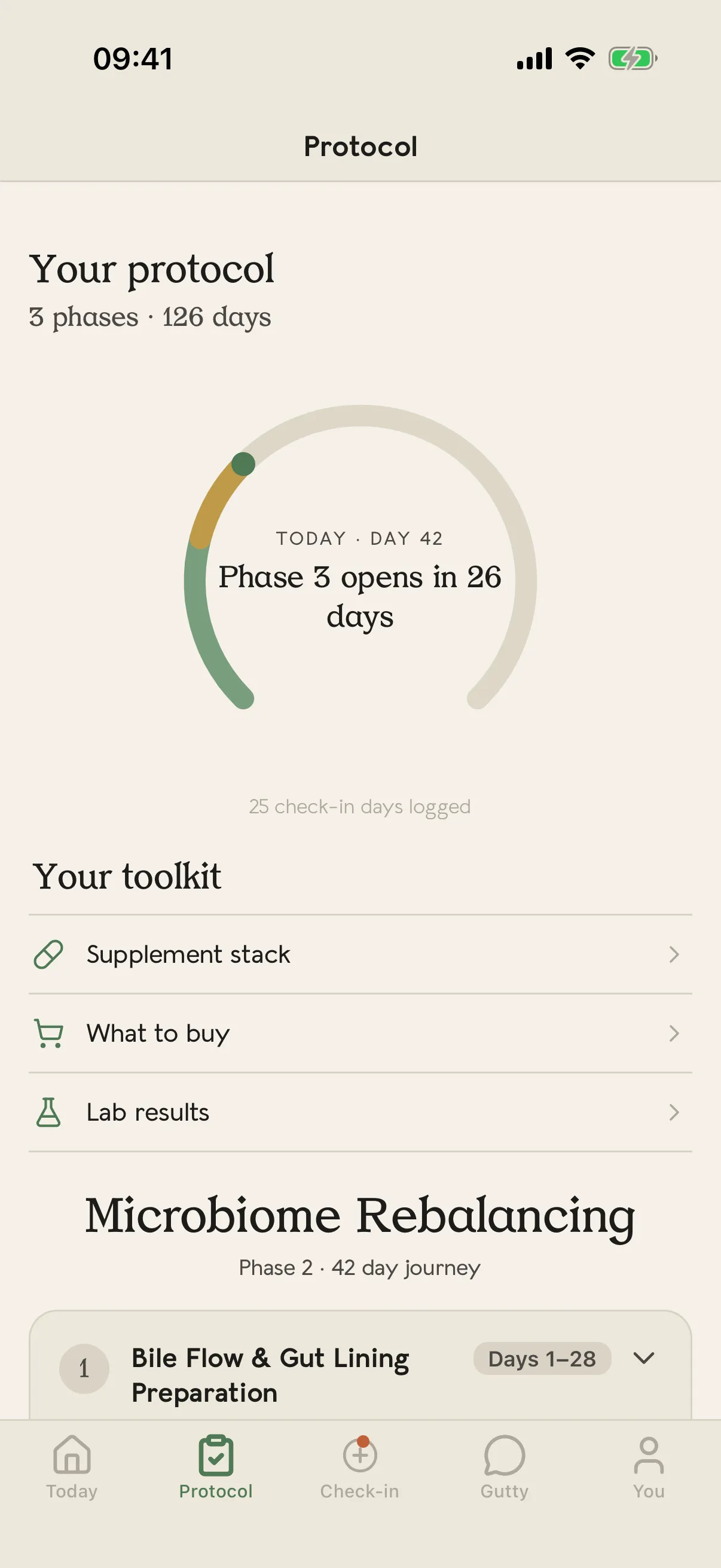
The whole point of the app is to give people certainty about what might be setting their symptoms off, so that they can find their own cause and have actionable steps to live a better life. And I found my own while designing and building this exact thing.
Some of you will already know about nervous system states, and I suspect some of you will recognise yourselves as sympathetic dominant. I am the living proof that you do not have to stand in fight or flight forever, and that there is a way back out.
I did not build GutFix only for people with gut problems. I built it for myself too, because I needed this. I needed it years earlier than I got it.
It is strange to see the loop close like that. A trauma I had years ago, and the help we are trying to give people today.
I am grateful for the hundreds of hours we have put into building GutFix and the effort that has gone into helping as many people as we can. Kieran and I both come from health backgrounds that were genuinely difficult. So we do not see ourselves only as the people helping you. We see ourselves as people who needed help, and we are trying to pass that on.
That is one of the big missions behind GutFix.
I am also glad that those of you who have used GutFix already, or who have spoken to Gutty, have seen that Gutty is genuinely there to help you.
I am happy we got to the point where we could put something like this into the world.
As a kid, I was never really sick, but around age 12 there was a period of a lot of stress.
I had just changed schools in the UK, from primary school to secondary school. You’re now the little fish in the big pond. And around that time it was a series of bad events: high stress leading to low stomach acid, and then I just so happened to eat what I would assume was the mozzarella or the chicken. One of those two gave me food poisoning on this very specific day.
After that I had the classic: throwing up, being sick, diarrhoea. And after that day, my gut just never felt the same. I woke up one morning so incredibly bloated I couldn’t move. Obviously I could, but it was extremely painful. I begged my mum not to send me to school, and she didn’t that day. The advice back then was, “You’ve got pain, have paracetamol.” I was having 6 or 8 paracetamol, wonderful. It shreds my stomach lining and reduces my acid production a fair bit, and from there it just got worse.
I couldn’t have anything sugary without intense bloating. I couldn’t walk back from school. I’d have to pause, and my friends would be there. I don’t think they ever actually said anything, but I’d style it out. “Yeah, just taking a break, a bit tired.” Really I was there with stomach cramps from the gas, from the bloating. It wasn’t gas you could release. Methane-dominant SIBO, so gas that’s trapped. The worst kind for me personally, considering I’ve had bouts of both, but they all have their own distinct challenges.
From there, we tried everything. My mum was insanely helpful throughout this process. She helped me change my diet. We would meal prep chicken and rice before school. She’d buy me the chicken, and she’d buy me the rice. I switched from cow’s milk to oat milk, maybe thinking that was a trigger, but there was no one clear trigger. I had these issues up until the age of 17 or early 18, and throughout my entire school life it bothered me a lot. I remember being in exam halls, and my stomach would start grumbling, borborygmus it’s called. People would turn around and look at me, and there’s no way you can escape. You’re in an exam hall. You can’t leave. It was just pure embarrassment.
It affected my focus a lot, affected my cognition a lot, and affected my mood a lot. Even in a few of my exams I got bad results, because that was a particular day for me. The stress of exams, paired with already having SIBO, made it worse.
The years after
How I got into where I am today: I’d worked a few jobs and quit a few of them, probably because I couldn’t handle the stress.
The SIBO had a big effect on me. I had a lot of anxiety. So I decided I wanted to get into business, the way a lot of young men do. I heard some advice: the best way to do business is to solve a problem you have yourself and help as many people as possible do it too. That stuck with me. I thought, “What’s my biggest problem?” That second, I’m like, “Look down. This bloating, this gas I can’t even release. This is my biggest problem.”
I got into research, and I will admit I fell into some paradigms at first. I fell into carnivore and restricting carbs, which I don’t recommend. I fell into just purely antimicrobials. I’d done oregano oil, allicin, berberine, black seed oil, just for the SIBO to come back every time, because, guess what, my stomach acid and my bile flow weren’t in check. I didn’t just spawn into this world with the knowledge I have now. I had to learn it the hard way, and the biggest lesson was this one: it was the environment that let SIBO in. From here I began posting content. A lot of it I look back on now and think, as you do, I was an idiot, but there’s a lot of good advice there. It’s just not the full picture.
What turned it
Over time I learned a lot of nuances.
I spoke to a lot of people. I learned how to find out issues by the timing of the issues. I learned how to read systemic symptoms for the gut lining, and I read a lot of research papers.
I wanted to know why things were able to get like they were. A lot of people get food poisoning and are fine, so what made someone susceptible? And if you knew that, could you make someone less susceptible in the future? That was my mission.
I don’t know every little thing about the gut, and I never set out to. What I can do is use a thinking framework and everything I’ve learned to ask the question that matters: why could this have happened?
With small intestinal bacterial overgrowth it’s not just motility. Most people link IBS to antivinculin antibodies, but what got the body to a state where it could form those antibodies? A damaged gut lining. Low stomach acid allowing a higher dose of food poisoning. You can see how there’s always a why, and that’s what I’m interested in, because the why dictates the how.
The why dictates the how.
Kieran
What I do now
When I had low stomach acid, that was why I had the SIBO, and then I got introduced to the how: betaine HCl in the short term, working on the stomach lining and my stress levels in the long term.
This is my exact goal with Gutty: to help you find your why. I don’t want to diagnose you. I don’t want to try to fix you. I just want to help you find why you keep getting these issues, why other things haven’t worked, and point you in the right direction so you can make educated choices about your health instead of running around in circles like I did, and I’m sure you have too.
There’s no shame in it, because a lot of the information out there was never designed to help us. It was designed to get views. Everyone has to do that to some degree, but I want to share the truth, the whole truth, nothing but the truth in your specific circumstances. I want to be able to pull from massive amounts of data and from my own thinking process to come up with the most likely why for your issues. That’s my entire goal with GutFix. If it can help one person like I could have been helped, if it can save one person the years of suffering I had to go through, then I am very happy to put this out there.
I’m happy for the hundreds of hours me and Jeremy put into this, and overall I’m happy my content can help at least some of you. I’ve spoken to over three dozen people now who have gone through this transformation just from reading my content, and that’s lovely to see. That’s what I want to see more of.
It was never the bacteria. It was the environment they landed in.
Kieran, co-founder
III
GUTFIX LTD
The company
GutFix is an AI gut-health system built to put things in the right order, with a reason for each. It works out what has to be sorted first for you, then builds forward from there, and the plan is built to need less as you go.
GUTFIX LTD, company number 17178510, United Kingdom. Reach us at hello@gutfix.ai.